Workplace Safety Culture: Building Safety From the Inside Out
This page has 0 clicks in GSC despite earning impressions. Meta was fixed in Round 2. Body content is still thin — this expansion addresses that. A companion blog post (Workplace Safety Culture Assessment: Drive Real Change) is already published.
Why Safety Culture Is the Real Safety Variable
Most organizations approach workplace safety through procedures, training, and compliance. Incident investigations, near-miss reporting protocols, personal protective equipment requirements, OSHA alignment — all of these matter. But they don’t explain the most consistent finding in occupational safety research: the organizations with the best safety records aren’t just the ones with the most rigorous procedures. They’re the ones where safety is built into how people think and behave, independently of whether anyone is watching.
That’s a culture outcome, not a compliance outcome.
Safety culture describes the shared values, assumptions, and norms that govern how an organization approaches safety — the degree to which safety is genuinely prioritized in decisions at every level, how openly people report risks, how leadership responds when safety and production tension with each other, and whether employees feel it’s safe to raise concerns.
Organizations with strong safety cultures have fewer incidents, faster near-miss reporting, lower severity when incidents do occur, and better long-term safety outcomes. The culture is the mechanism. Compliance is the floor.
Characteristics of High-Reliability Safety Cultures
Safety researchers have identified several consistent characteristics of organizations with the strongest safety cultures. They include:
Psychological Safety Around Risk Reporting
In strong safety cultures, employees at every level feel safe reporting near-misses, unsafe conditions, and safety concerns without fear of blame, embarrassment, or retaliation. This sounds obvious but is far from universal. Many organizations discover that near-miss reporting drops after a visible incident — exactly when you want it to go up.
Leadership That Models Safety Behavior
The most powerful predictor of frontline safety behavior is what employees observe their leaders doing. When leaders visibly prioritize safety — stopping production for a safety issue, participating in safety walks, responding constructively to concerns — it signals to the organization that safety is real. When leaders make decisions that implicitly trade safety for speed or cost, that signal is equally powerful.
Shared Ownership, Not Safety Department Ownership
In low-safety-culture organizations, safety belongs to EHS and is someone else’s problem. In high-safety-culture organizations, everyone owns safety. Operators flag hazards. Supervisors build safety into daily briefings. Senior leaders include safety in operational reviews. The diffusion of ownership is both a cause and effect of strong safety culture.
Learning Orientation After Incidents
How an organization responds to safety incidents — and near-misses — tells you everything about its safety culture. Blame-oriented cultures investigate to find fault. Learning-oriented cultures investigate to understand the system conditions that allowed the incident to happen. The latter produces durable safety improvements; the former produces defensiveness and underreporting.
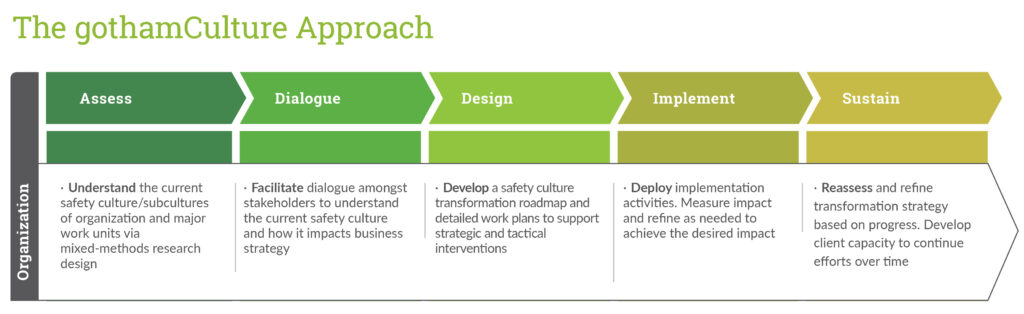
The gothamCulture Approach to Safety Culture
gothamCulture brings organizational culture expertise to workplace safety challenges. Our work is not a substitute for technical safety programs — it’s the complement to them. We help organizations understand the cultural dimensions that determine whether their safety investments work.
Safety Culture Assessment
We conduct structured safety culture assessments using the Culture Mosaic Survey supplemented by safety-specific indicators. The assessment measures psychological safety, leadership safety modeling, reporting norms, and safety ownership across the organization. Findings are benchmarked against patterns we’ve observed in high-reliability organizations.
Leadership Development for Safety
Front-line supervisors are the most important safety culture variable in most organizations. They’re the interface between workers and management, and their daily behavior determines whether safety norms are reinforced or eroded. We develop supervisors’ capability to model safety behavior, handle safety concerns constructively, and lead safety conversations that aren’t just compliance checklists.
Culture Change Integration
When safety culture is significantly misaligned — particularly in organizations that have experienced serious incidents or face chronic underreporting — we support broader culture change work that addresses the underlying assumptions driving unsafe behavior. This goes beyond safety training to address the organizational systems and leadership behaviors that create the safety culture in the first place.
Industries We Work With
Safety culture work is most relevant in industries where safety risk is an operational reality: manufacturing, energy, construction, transportation, healthcare, and industrial services. It’s also increasingly relevant in technology and knowledge work environments where psychological safety — a cousin of safety culture — affects error reporting, product quality, and employee wellbeing.
Start With a Safety Culture Assessment
If you’re trying to understand where your organization’s safety culture stands — or why safety metrics aren’t improving despite compliance investments — a structured assessment is the right starting point. Contact gothamCulture to discuss a safety culture assessment for your organization, or explore the Culture Mosaic Survey to see how we approach cultural diagnosis.